


To understand the rapid shift to Very Small Form Factor (VSFF) fiber connectors like MMC or SN-MT and pre-terminated connector solutions in the modern Data Center needs an appreciation of the role of Spine-Leaf architectures, the need for fast installation within a Data Center facility plus the importance of the quality of the connection.
Introduction
As data center (DC) architectures evolve to accommodate the unique demands of artificial intelligence (AI) workloads, fiber infrastructure is undergoing radical transformation, especially in optical fiber cable and connector technology.
The deployment of Spine-Leaf (or Clos) network topologies in modern DC’s is the main driving force for the extreme fiber densification witnessed. These architectures support the ultra-dense fiber mesh networks needed for the compute processes within the AI DC backend network. However, this fiber densification means that multi-fiber ribbon counts in DC’s are also increasing to the extent that it becomes impractical to splice these connectors on site within the DC and achieve the time-to-market and quality parameters required.
Spine-Leaf Architecture and Fiber Densification
In a traditional three-tier DC architecture (Core, Aggregation, Access), switches only connect to a few devices in the tier directly above them, and they rely on protocols like Spanning Tree Protocol that block redundant physical links to prevent network loops. Spine-Leaf flattens this hierarchy into just two layers and changes the fundamental rules of how those layers connect from a fiber perspective.
The ‘Every-to-Every’ Connection Rule means more fiber
The defining characteristic of Spine-Leaf networks is that every single leaf switch must connect to every single spine switch.
If a data center has 4 spine switches and 50 leaf switches (located as Top-of-Rack switches); this requires 200 dedicated physical fiber links (4×50). If the facility then expands to 8 spines and 100 leaf switches to enable more bandwidth, the number of interconnects jumps to 800 (8×100): the switch requirement has doubled but the number of fiber links has quadrupled.
Equal-Cost MultiPath (ECMP) means more fiber
Unlike older networks that leave redundant backup fiber cables sitting dark, Spine-Leaf uses Layer 3 routing protocols and Equal-Cost Multipath (ECMP) to keep every physical link active simultaneously. Traffic is load-balanced across all available paths. Because every added fiber immediately translates into usable bandwidth, important for AI compute, data center operators plan for as many parallel fiber links as their switch/cross-connect faceplates can physically handle.
The Rise of East-West Traffic means more fiber
Legacy DC networks were built for North-South traffic flow (data traveling between a server and the user). Today’s applications rely heavily on East-West traffic (servers communicating to other servers within the same data center).
Spine-Leaf networks are optimized for East-West traffic flow. By forcing data to travel exactly two hops (Leaf-to-Spine-to-Leaf switch) no matter where the destination server is within the DC facility, it guarantees predictable, ultra-low latency which is essential for AI compute. Achieving this consistent two-hop path requires a dense, fiber-heavy backbone that connects the entire fabric together.
AI and Non-Blocking Oversubscription means more fiber
In standard enterprise deployments, operators might accept a 3:1 oversubscription ratio (for example; 300G of server capacity sharing a 100G uplink to the spine). However, AI clusters and high-performance computing cannot tolerate such bottlenecks. They often require a 1:1 (non-blocking) ratio, meaning the total uplink bandwidth from the leaf to the spine switch must equal the total downlink bandwidth to the servers. To achieve this DC architects must run significantly more high-speed optical uplinks from each leaf switch, dramatically increasing the fiber count of the fiber trunk cables deployed in the whitespace of a DC.
Scalability means more fiber
When a Spine-Leaf DC network needs more capacity, operators don’t replace old switches with larger ones (scaling up). Instead, they add more spine switches to increase bandwidth, or more leaf switches to increase server capacity (scaling out). Every time a switch is added to the network fabric, a new web of fiber must be available to connect it to the rest of the back-end network.
VSFF Connectors Replacing Legacy Connector Interfaces
Much higher fiber connectivity in a data center means more fiber connections in a rack. The DC rack footprints are standardised and will not change so the density of fiber connections per rack needs to increase significantly.
Spine-Leaf based networks and their topological need to manage hundreds of thousands if not millions of fibers in a DC has made traditional LC duplex fiber connectors unsuitable for modern DC links because of their relatively large physical footprint. Switch port densities are increasing so quickly that even the newer MPO (Multi-fiber Push-On) connector is too large to accommodate the required number of ports on a switch faceplate.
This has led to the development of VSFF connectors, like the SN-MT (Senko Nano-Mount) and the MMC (Multi-fiber Micro Connector by US Conec). These connectors deliver up to a 3x increase in connector density compared to standard MPO connectors. VSFF connector solutions allow data center operators to deploy within a 1RU patch panel, fiber densities from 144 fibers up to 4,224 fibers for MMC Base 16 connectors, significantly increasing faceplate fiber connector densities.
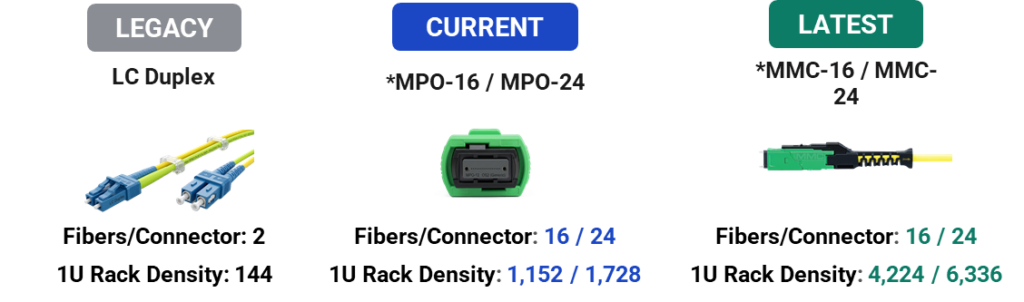
Increasing Faceplate Connector Density
AI DC’s increasingly use MMC formats for backend network links. For 400G/800G links, 16-fiber MMC connectors are quickly becoming the connector of choice because of the standardization on 8 high-bandwidth lanes with 2 fibers per lane (8 transmit fibers + 8 receive fibers) in the latest transceivers. The transition to 1.6T is expected to further drive the use of 16-fiber to maintain bandwidth density. However, this shift does necessitate precise polarity management, advanced testing procedures and systematic labelling to ensure that the myriad of separate transmit and receive fibers are correctly aligned throughout the network fabric.
By using MMC-to-MPO breakout harnesses, DC operators can also manage the transition between the ultra-dense switch ports and the more traditional fiber infrastructure within the racks.
Furthermore, as network speeds scale from 400G and 800G to 1.6T, stringent insertion loss and return loss budgets in conjunction with the deployment of ultra-high fiber count multi-fiber ribbon connectors, render field termination (within the DC) increasingly impractical, driving the move toward high-precision factory-terminated optical cabling.
Why VSFF is Critical Right Now
The push toward VSFF isn’t just about saving space; it’s a structural requirement for the modern AI data center. As emerging transceiver form factors (like OSFP-XD) and Co-Packaged Optics place optical engines directly next to the Application Specific Integrated Circuit, the external fiber interfaces must be ultra-compact and easy to manage.
The Need for Factory-Terminated Assemblies
While the form factor of the connector solves the density challenge, the performance of the connection relies entirely on its termination quality. As speeds increase, the tolerance for signal impairment quickly diminishes towards zero. Factory termination of MPO, MMC, and other multi-fiber connectors is vastly superior to field termination for several critical reasons.
Stringent Optical Loss Budgets
Advanced encoding schemes like PAM4 (4-Level Pulse Amplitude Modulation) used in 400G, 800G, and 1.6T transmission are highly sensitive to optical noise and signal attenuation. Under current TIA-942-C and IEEE 802.3 standards, the total channel insertion loss budget is exceptionally tight. Factory termination utilizes precision, automated polishing processes that guarantee end-face geometry within micrometer tolerances. This achieves ultra-low insertion loss and optimal return loss, performance levels that are very difficult to replicate reliably in the field.
Connector Cleaning
A single microscopic dust particle on an MMC (or MPO) end-face can scatter light, causing unacceptable bit error rates in high-speed links. Factory-terminated cables are polished, rigorously cleaned, and instantly capped in ISO-certified cleanroom environments.
However, connector technology continues to advance with the development of next-generation expanded-beam optics (EBO) ferrules designed by US Conec that integrate into the VSFF MMC platform. Rather than relying on actual fiber-to-fiber touch, it uses internal lenses to expand and collimate the light beam across the optical interface (the air gap). This makes the connection far less sensitive to dust, debris and misalignment and generally easier to use than traditional physical contact connectors.
Speed of Deployment
AI data centers prioritize rapid deployment (plug-and-play). Factory-terminated, pre-tested trunk cables drastically reduce installation time, labour costs, and the need for specialized on-site splicing equipment. Moreover, factory-controlled processes utilize high-density optical cable constructions, such as Intermittently Bonded Ribbon (IBR) which provide superior flexibility and routing within tight containment pathways in a DC.
Conclusion
The convergence of AI workloads, high-density Spine-Leaf architectures, and 800G/1.6T optical transceivers dictates a new paradigm in data center cabling. VSFF connector families such as MMC and SN-MT provide the necessary physical density, while factory termination guarantees the optical performance and reliability required to stay within stringent loss budgets. For data center operators building the infrastructure of tomorrow, adopting factory-terminated VSFF fiber infrastructure is a mandatory step toward achieving maximum scalability, compliance with TIA and IEC standards, and long-term network resilience.