
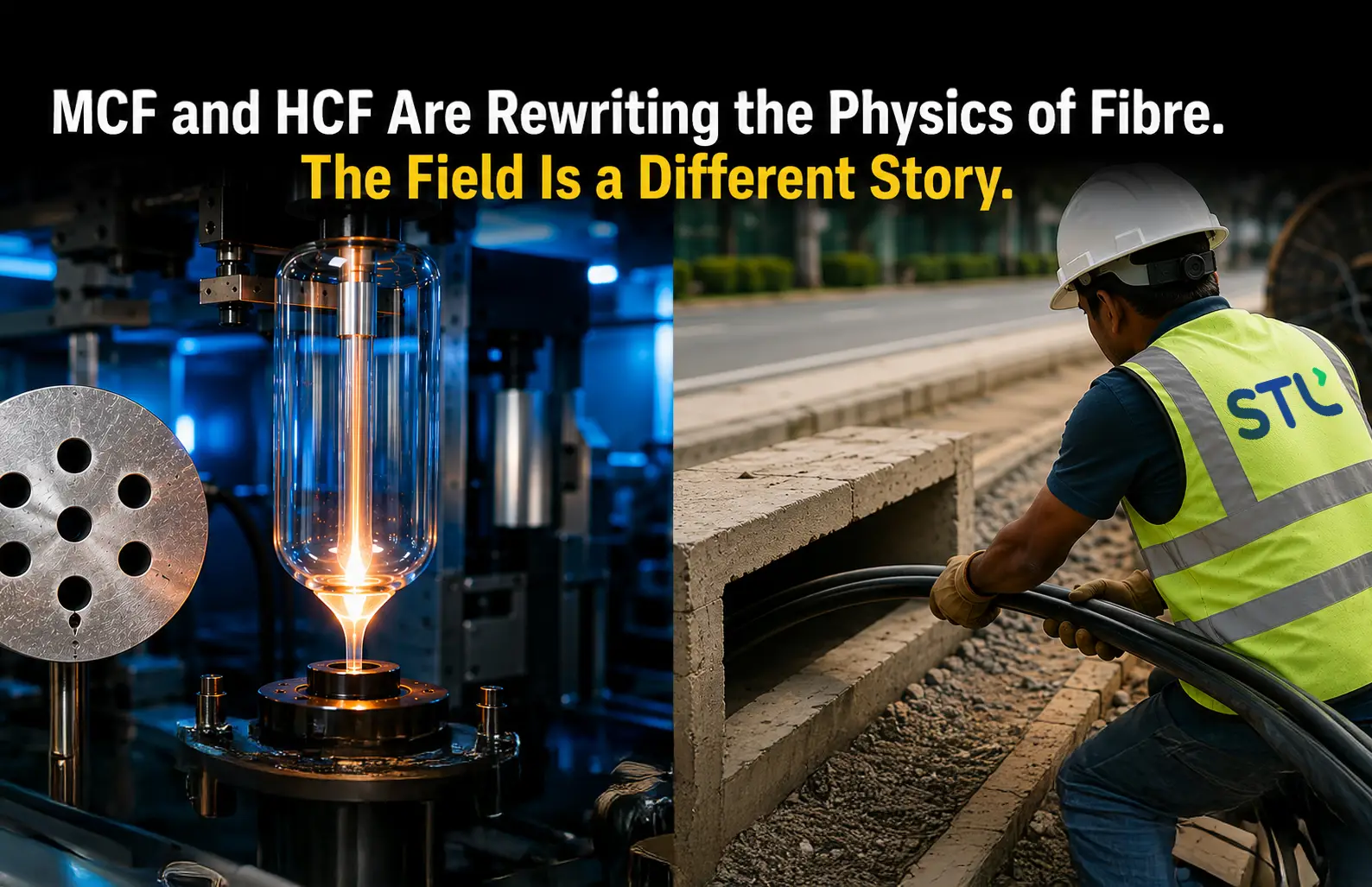
Picture a manufacturing floor.
On one side, a fibre preform is being drawn into something extraordinary. Seven independent transmission cores. Inside a cladding, the same diameter as the cable your technician pulled last week.
On the other side of the same floor that technician is using tools and muscle memory unchanged for twenty years.
That’s the honest picture of optical networking today.
The physics has moved.
The field is still catching up.
And most in the industry won’t say that out loud.
Contents
The promise is real. Let’s start there
MCF (MultiCore Fibre) packs multiple transmission cores into a single fibre. Same 250-micrometre coating as standard SMF. Same conduit. Same cable footprint. Dramatically more capacity.
HCF replaces the glass core with air. Light travels faster. Latency drops. Signal degradation at high power is gone.
These aren’t white papers anymore.
Microsoft deployed HCF inside Azure data centres and documented up to 47% improvement in data speeds. Measurably lower latency for AI and cloud at scale. In March 2025 they called it production-ready.
STL ran an 800G transmission trial over four-core MCF across Colt’s London metro network.
9 km. 63 km. Chromatic dispersion, polarisation mode dispersion, crosstalk, throughput, fault analysis, tested comprehensively.
STL also deployed MCF cables at IIT Madras, where India’s first quantum key distribution transmission ran over a 100km four-core MCF network. Underground and aerial infrastructure simultaneously. A world first.
And in FY26, STL introduced India’s first hollow core fibre cable. Air-core architecture. Approximately 46% faster transmission. Ultra-low latency. HCF moving from global trial into domestic commercial development.
These aren’t isolated data points. They’re a consistent signal.
MCF and HCF work in real networks under real operating conditions.
Now for the part the industry rarely names
Field deployability at mass scale, isn’t there yet.
That’s not a criticism of the technology. It’s an accurate reading of where the ecosystem stands. And understanding it clearly is what separates operators who will transition well from those who will be caught flat-footed.
The barriers are specific.
Splicing MCF requires perfect rotational alignment of every core across two fibre ends. Standard fusion splicers can’t do that. Specialised equipment using advanced alignment algorithms can achieve near-perfect results- in controlled conditions. A street cabinet in winter is not a controlled condition. A congested urban duct environment is not a controlled condition.
HCF splicing introduces a different challenge. Joining HCF to standard fibre creates an air-glass interface that reflects light. Specialised connectors can manage this. But the tooling isn’t standardised yet. Not widely distributed. Not priced for volume deployment.
Then there’s mechanical fragility. The hollow structure that gives HCF its performance advantages also makes it more sensitive to mechanical stress, sharp bends, and the handling that happens on every job site globally. Cable designs are evolving. But ruggedisation has cost implications operators need to factor deliberately.
Standards maturity is a live constraint. ITU-T’s G Supplement 87, published in 2025, gives the industry its first global SDM framework. Real progress. But unified standards across connectors, testing, fan-in/fan-out devices, and cross-vendor interoperability are still maturing.
The ecosystem is being built in parallel with early deployments. MCF transceivers. Multicore amplifiers. Adapted test equipment. A small number of vendors today. Volume manufacturing ahead.
Deploying at scale requires the full ecosystem, not just the fibre.
So what does this mean for people making infrastructure decisions right now?
The London metro trial, the IIT Madras quantum network, the Azure deployment, these are proof points, not finish lines.
They confirm, the physics works in operational environments.
They don’t yet confirm that the field ecosystem can support mass rollout.
MCF and HCF belong in your technology roadmap today.
They don’t belong in next-quarter deployment plans without a careful ecosystem assessment.
That’s not a hedge. It’s a strategic judgment.
Organisations that start building internal expertise in spatial multiplexing now, evaluate ecosystem partner readiness now, design network architectures with headroom for MCF transition now, will move decisively when full field deployability arrives.
Those waiting for the technology to be fully mature before engaging with it will face a steeper, more expensive catch-up.
STL’s position in this transition is built on exactly that logic. From the Colt London metro trial to India’s first quantum-secured MCF network to the development of India’s first HCF cable, the work is oriented toward closing the lab-to-field gap systematically, not declaring it closed prematurely.
The fibre that will carry the next decade of AI traffic is being drawn today.
The decisions being made now will shape how ready the world is to use it.
STL is a global leader in advanced connectivity solutions, providing end-to-end solutions for AI-ready infrastructure, FTTx, rural, enterprise, and data centre networks. With manufacturing facilities across North America, Europe, and Asia, STL delivers optical and digital solutions in more than 100 countries.