
What happens when you touch something hot?
Before you even realize it, your hand moves away instantly.
Your brain sends signals.
Your nerves carry them.
Your body reacts in milliseconds.
That’s because the human body is constantly communicating within itself.
Now imagine if the nervous system stopped working.
The brain would still exist.
The muscles would still exist.
But communication would fail.
Modern data centers work in exactly the same way.
The Nervous System of a Data Center
Inside a data center, thousands of systems are constantly talking to each other:
- Servers
- Switches
- Storage systems
- AI clusters
Data is moving every second.
And just like the human body, this communication depends on three critical things:
- A pathway to carry signals
- Strong connection points
- A system that translates and transmits information
That’s where fiber, connectivity, and transceivers come in.
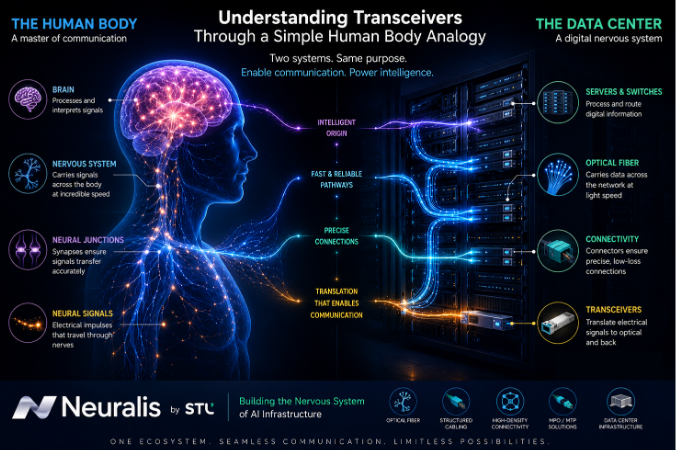
Fiber Cables are the Nerves
They carry enormous volumes of information across the data center at extremely high speeds.
Every cloud application, AI workload, video stream, or enterprise transaction depends on these optical pathways working seamlessly.
As AI and hyperscale data centers grow, these pathways need to become:
- Faster
- Denser
- More reliable
Because ultimately:
The faster the brain thinks, the stronger the nervous system needs to be.
This is why optical infrastructure has become the backbone of modern digital ecosystems.
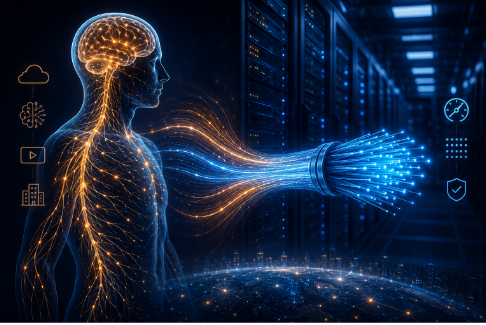
Connectors are the Neural Joints
In the human body, signals move through highly precise neural junctions.
Even tiny disruptions can affect communication.
Similarly, in a data center, connectors ensure signals move accurately between fiber links.
At higher speeds like 800G, 1.6T and 3.2T, precision becomes critical.
A tiny loss or misalignment can impact overall network performance.
That’s why modern data centers need high-quality, low-loss connectivity systems built for high-density environments.
Transceivers = The Brain’s Translators and Messengers
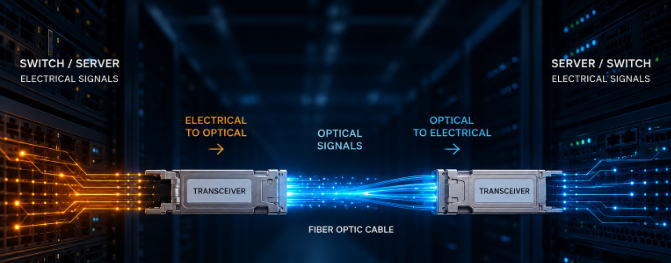
Now comes the transceiver.
The word transceiver comes from:
Transmitter + Receiver
And that explains its job perfectly.
Inside the human body:
- The brain sends electrical signals through nerves
- Different parts of the body understand and react to them
Inside a data center:
- Servers and switches generate electrical signals
- Fiber cables carry optical signals using light
The transceiver acts like the brain’s translator and messenger.
It:
- Receives electrical signals
- Converts them into optical signals
- Sends them through fiber
- Receives optical signals back
- Converts them again into electrical signals
In simple terms:
It helps machines “understand” each other over fiber networks.
Why This Matters More Today
AI and hyperscale data centers are creating massive amounts of internal traffic.
This is pushing networks toward 800G, 1.6T and 3.2T.
As transceivers become faster and smarter, they also demand:
- Better fiber
- Better connectivity
- Lower-loss architectures
Because the nervous system must evolve together.
A powerful brain alone is not enough.
The body also needs strong neural pathways.
Neuralis: Inspired by the Intelligence of Connected Systems
The name Neuralis comes from the idea of neural intelligence and connected pathways.
Through Neuralis, STL delivers:
- Optical fiber
- Structured cabling
- High-density connectivity
- MPO/MTP solutions
- Data center infrastructure
designed for the demands of modern digital ecosystems.
You can explore a wide range of data center solutions and infrastructure offerings on the
STL Technologies website.
Because in the AI era, infrastructure is no longer just about connectivity.
It is about enabling intelligent communication at scale.
Final Thought
A modern data center is not just a collection of hardware.
It is a living communication system.
- Fiber acts as the nerves
- Connectivity acts as the neural junctions
- Transceivers act as the translators enabling communication
Together, they create the digital nervous system powering today’s connected world.
And through Neuralis, STL is helping build the infrastructure that keeps this intelligence moving.