
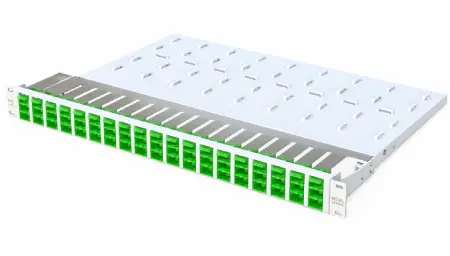
MMC16 Panel
MMC16 Panel
MTP · MPO · MMC · SN
B8 / B12 / B16
Products
Six product families covering every layer of whitespace connectivity — from ultra-high-
density enclosures to copper management.
A full range of ultra-high and high-density fiber enclosures engineered to maximise rack density and simplify fiber management in AI data center environments.
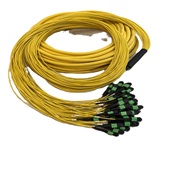
Factory assembled and tested MTP/MPO (Base 8/16) trunk cables built for the AI data center backbone networks. Day-one ready for rapid deployment with no field termination risk. Designed to cater for multiple future network upgrades.
Precision-engineered for 800G/1.6T AI data center environments, where fiber geometry and length consistency are critical to maintaining optical link budgets and eliminating packet loss.
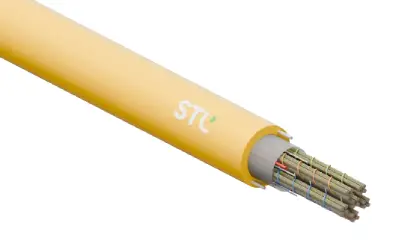
Ultra-high-density backbone cable built with Intermittently Bonded Ribbon (IBR) technology. Engineered to carry the ultra high fiber counts AI infrastructure demands.
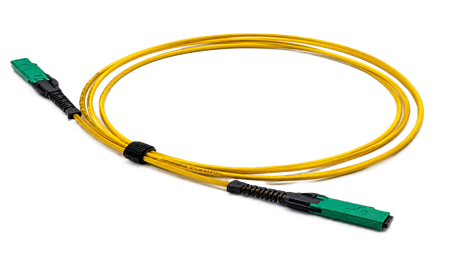
As AI GPU interconnect fabrics migrate to 800G and 1.6T per-lane optics, the physical port density required at the patch layer has outrun what traditional MTP/MPO-8 can deliver. The MMC connector — engineered with a compact 250µm pitch TMT ferrule and available in 12F, 16F, and 24F configurations — reduces connector footprint by nearly 50% versus conventional MPO while maintaining full backward compatibility with MT and MT-16 ferrule interfaces.
STL’s MMC product range — including 12F, 16F, and 24F array cords, pigtails, and the industry’s most comprehensive 1U panel system — means your team can specify the most advanced VSFF infrastructure available today, with STL as your single point of accountability.
Very Small Form Factor connectors for next-generation hyperscale AI builds. STL's MMC array cords and 54-port 1U panels deliver up to 3456 fibres per rack unit — nearly 50% denser than traditional MPO solutions.
The industry-standard multi-fibre connectors — STL supports both Base-8 (MTP/MPO 8F) and Base-16 (MTP/MPO 16F) array cords and trunks, including OFNP, LSZH/CPR variants, and multimode APC options.
SN VSFF duplex connectors for ultra-compact single-mode applications, alongside LC duplex zipcord and unibody patch cords with LSZH/OFNR and OFNP ratings for all fire-safety zones.
Micro-Duplex Connector support in STL's UHD enclosure platform — 432 MDC ports per 1U chassis for the highest-density individual-fibre access applications in the data hall.
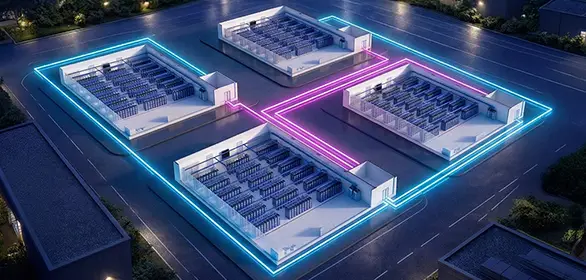
Data Center Interconnect (DCI) is the high-speed optical backbone that links data center buildings to one another - enabling the seamless, low-latency flow of data across campuses, metros, and regions that modern cloud and AI workloads demand. STL brings DCI expertise helping operators build interconnect infrastructure that scales efficiently, meets the strictest global standards, and keeps pace with the accelerating demands of AI-era data centers.

Explore STL's solution families across FTTH, Data Centers, and Enterprise networks including Single dwelling, Multi dwelling, Central office, Rural FTTH, Cloud Communication and Fiber optic sensing solution - Sensron.
Data center whitespace is the actual floor area where IT equipment, like servers and racks, are housed and operated. It is an inside part of the facility, distinct from the gray space that holds the supporting power and cooling machineries. Whitespace is the heart of a data center where computing power takes shape, consisting of the rows of racks and the specialized flooring designed for airflow.
Multicore fiber acts like a multi-lane highway, squeezing several independent paths for light into a single glass strand. This allows a single cable to carry significantly more data than standard fiber, making it the perfect solution for high-traffic data centers where space is limited.
What is Hollow Core Fiber (HCF)?
Hollow core fiber replaces the solid glass center of a cable with an air-filled channel, allowing light to travel roughly 50% faster. By removing the "drag" of the glass, it drastically reduces latency, which is critical for high-speed and real-time digital applications.
What are MCF Connectors?
MCF (Very Small Form Factor) connectors are high-density fiber optic connectors designed to be significantly smaller than standard types, allowing for more connections in cramped spaces. They are designed to support the next generation of high-speed optics like 400G and 800G that require massive amounts of data to flow through tiny ports.
Hollow core fiber replaces the solid glass center of a cable with an air-filled channel, allowing light to travel roughly 50% faster. By removing the "drag" of the glass, it drastically reduces latency, which is critical for high-speed and real-time digital applications.
MCF (Very Small Form Factor) connectors are high-density fiber optic connectors designed to be significantly smaller than standard types, allowing for more connections in cramped spaces.
They are designed to support the next generation of high-speed optics like 400G and 800G that require massive amounts of data to flow through tiny ports.
G.654.E solves for distance, but HCF solves for time. In the AI era, the bottleneck isn't how far the signal goes, but how fast the GPU clusters can synchronize. If your latency is 30% higher, your AI training takes longer and costs more in compute power. HCF is an investment in operational speed, not just a cable.
In solid glass (G.654.E), as you increase laser power to go further, you hit 'Non-Linear'. Because HCF guides light through air, you can blast massive amounts of power with zero distortion.
Traditional optical fibres have physical 'Glass Ceiling because light travels through solid silica, it is fundamentally 30% slower. In an AI-driven economy, that 30% makes a huge difference. You get 1.5 milliseconds of latency that glass steals from your network every 1,000 kilometers. HCF allows you to run 800G and 1.6T speeds over distances where traditional glass would simply slow down the signal.
Your input is valuable to us. Fill out the form below and we’ll get in touch as soon as possible.
Please wait while you are redirected to the right page...