
hide

Data center Interconnect Solutions

The industry’s highest-density DCI fiber cable – engineered for AI-era traffic, 400G/800G/1.6T migration.

The Challenge

Maximizing Data Center Efficiency with STL Neuralis

Every data center campus eventually hits the same wall: duct capacity runs out, and re-trenching is the most expensive, disruptive path to adding fiber. Each speed cycle — 400G, 800G, and beyond — demands more fibers per link, accelerating that constraint. Solving entry points challengs like messy transitions and budget losses that degrade with every field intervention. STL solves this with its pre-terminated cables that offer maximum fiber count in the smallest footprint.

FLAGSHIP OSP CABLE

Celesta® OSP IBR — High Fibre Count Campus Cable

STL’s flagship OSP cable — 96F to 6912F, the widest range in its class. IBR format combines loose-tube installation flexibility with mass-fusion-splicing speed: 6912F joint closures in hours, not days. The I/O rated variant (144F–6912F) routes from campus duct to MMR without a greyspace splice, eliminating 0.5–1.5dB of insertion loss. 

Key Specifications

PRETERMINATED SYSTEM

Indoor/Outdoor Pre-Terminated Fibre Trunks & Pre-Stubbed Enclosures

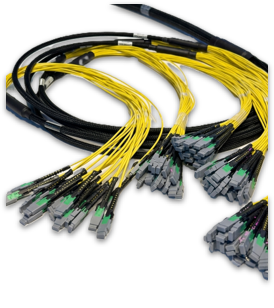
Factory pre-terminated I/O trunks — every trunk ships with tested IL documentation and pre-configured polarity. The Pre-Stubbed Enclosure combines spliced outdoor entry with connectorised indoor patch field in one product, eliminating a separate splice closure at the MMR boundary. 

Core Advantages

ENTRY POINT INFRASTRUCTURE

Fiber Entrance Cabinet (FEC) — Greyspace & MMR

Purpose-built termination for where outside plant cables enter the data centre. Accepts high-count Celesta IBR cables, accommodates multiple entry conduits, and provides organised, labelled splice tray management for thousands of fibres.

Application Highlights

JOINTING & CLOSURE

ORC / CORC Joint Closures

Re-enterable splice closures for mid-span and branch joints. ORC (full-size, inline and branch) and CORC (compact, space-constrained) both provide field re-access and re-seal without new hardware — essential for cable plants managed over decades.

Deployment Scenarios

STL Neuralis DC Interconnect Solutions

From flagship campus cables to pre-terminated systems and entry point infrastructure —
engineered for 30-year lifecycle performance.

Celesta IBR outdoor duct cable

Ultra-high-density OSP cable used in ducts. STL combines it’s intermittently bonded ribbon technology with mass fusion splicing productivity.

  • Supports both blowing/jetting and pulling deployment
  • Gel-free dry water-blocking and aramid-reinforced strength members
  • Fiber G.657.A2 bend-insensitive SMF

Celesta IBR indoor/Outdoor cable

High-density cable bringing IBR ribbon architecture and mass fusion splicing efficiency to controlled building environments. Optimised for equipment rooms and cabinets and other data center applications.
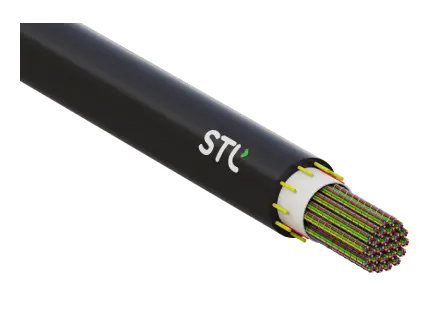
  • Colour-coded bonded ribbons for rapid identification
  • Engineered for mid-span access
  • Fiber G.657.A2 bend-insensitive SMF
  • Fiber Ultra high density 200 um fiber

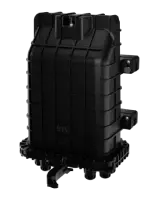
OSP cabinets & high-density closures

The gateway between outside connectivity and internal AI whitespace. Leveraging our outside plant expertise, STL engineered solutions for fiber entrance and secure termination before data reaches the GPU clusters.
Specifications
  • Fiber Entrance Splice Cabinets (FEC)
  • Outside Plant Cabinets
  • Joint Closures

Deployment Scenarios

Hyperscale Campus

The backbone ring connecting data halls across a hyperscale campus. AI clusters, spine fabric, and storage all converge here — demanding maximum density and minimum duct occupancy. A single Celesta 6912F pull is the complete solution.

Building Interconnect — AI Compute to Spine

GPU compute buildings connecting to spine switches in AI hyperscale topology. A building housing 4,000+ H100s may saturate a 3456F cable. The 6912F serves a full AI compute building in a single pull — leaving 62% of duct capacity free.

Colocation MMR Build-Out

STL's FEC cabinets and pre-stubbed enclosures provide organised, scalable MMR entry for every carrier and tenant — with enough dark fibre reserve in a single Celesta I/O cable for years of additions without further pulls.

OSP to Inside Plant Transition

STL's I/O Celesta IBR routes from campus duct through the building entry to the MMR — eliminating the greyspace splice, recovering 0.5–1.5dB, and simplifying the build.

DCI / Long-Reach Campus Extension

Connecting a primary campus to a DR site, colo, or remote PoP. The Celesta 6912F's mass-fusion-splicing efficiency makes it the preferred medium for long-haul extension builds where schedule, budget, and fibre count are all constrained.

Why Interconnect Matters the most today?

Earlier data centre networks served a simple flow: requests in, processing, responses out. Fibre plants were sized conservatively — internal traffic was modest and predictable.

AI changed this completely. Every GPU must constantly exchange data with every other simultaneously — creating internal traffic volumes that dwarf what campus infrastructure was built to handle. The interconnect layer now carries cluster-to-cluster movement traditional architectures cannot accommodate.

Scale Requirements

A single AI cluster may need 50,000–100,000 optical connections, every one consuming campus interconnect fibres. This is the design requirement of data centres being built today.

Higher Speeds, More Fibres

At 400G/800G, higher line rates consume more fibres per port — 16F vs 8F for 100G. A 1024-port spine switch multiplies that into thousands of additional fibres. Specify for hardware arriving two or three generations from now.

Speed migration should leave the cable plant untouched — possible only if enough dark fibre was specified for each generation. Insufficient fibre count forces civil works exactly when operators can least afford them.

What STL Interconnect Solves?

Density Without Disorder

Max fibres. Minimum duct. No re-trenching. 

Campus duct is the scarcest asset — once full, adding capacity is costly. The fibre count at the first pull determines how quickly a campus hits that constraint. 

Celesta 6912F carries more fibres than any other commercial OSP cable — with a smaller OD than equivalent loose-tube. In a 110mm duct it occupies ~38%, leaving 62% free. I/O variants eliminate the greyspace splice — one continuous cable, zero additional IL.

Faster Path to Higher-Speed Architectures

Speed upgrades as transceiver swaps. 

Every speed cycle demands more fibres per port. Size for current demand and every migration forces a choice: re-trench, or constrain the upgrade. 

The 6912F dark fibre reserve eliminates this choice: 3–4 migration cycles without returning to the duct. I/O pre-terminated trunks are qualified for 400G/800G IL budgets, factory-tested documentation on every trunk. 

Cleaner Campus and Building Connectivity

Organised and maintainable from duct to MMR. 

The building entry is historically one of the most problematic campus sections — multiple cables, unlabelled fibres, documentation that doesn’t match what was installed. 

STL’s pre-stubbed enclosures combine spliced outdoor entry with connectorised indoor patch field in one product. FEC cabinets provide organised splice management. Every trunk ships with factory polarity documentation — as-built records accurate from day one. 

Operationally Simpler Moves, Adds, and Changes

Operations that don’t disrupt live infrastructure. 

The real cost is 20–25 years of moves, adds, and changes. Field splicing or specialist tooling for routine changes accumulates operational cost that dwarfs capex. 

Dark fibre activation adds a carrier or tenant without a cable pull. Re-enterable ORC/CORC closures allow field re-access without new hardware. Pre-terminated trunks turn circuit changes into patch cord swaps. Standardised connectors across the full STL portfolio — no specialist tooling required. 

FAQs

DCI (Data Centre Interconnect) is the outside plant fibre connecting data halls, buildings, and MMRs — the physical layer all networking equipment depends on. Unlike whitespace patching, DCI challenges span fibre count, environmental rating, and long-term resilience. STL's Celesta 6912F is the highest fibre-count DCI cable available. 

Pre-terminated trunks are preferable — better IL consistency, documented specs on every trunk. Field assembly can be appropriate when lengths cannot be pre-specified, this is usually rare. The cost premium is typically recovered on the first change event.

AI clusters demand 5–10× more fibres than 100G-era builds. At 400G/800G, 16+ fibres per port multiply into massive spine switch demand. Compressed AI build timelines make IBR mass fusion splicing — hours per joint — a critical advantage. 

OSP cables are certified outdoors only — requiring a greyspace splice at building entry. I/O cables carry both outdoor and indoor fire ratings (LSZH / OFNP), routing continuously from duct to MMR — eliminating the greyspace splice and recovering 0.5–1.5dB. STL's Celesta I/O: 144F to 6912F.

The Celesta 6912F's IBR format produces a smaller OD than equivalent loose-tube cables. In a 110mm duct it occupies ~38% — leaving 62% free. STL provides duct fill analysis free for all interconnect projects.

Explore our Data Center Solutions
for India and Middle East.

Explore more STL Solutions

Data Center Whitespace

Data Center Whitespace refers to the purpose-built space with a data center facility where critical IT infrastructure - relating to compute, storage, and networking - is deployed alongside the power and cooling systems that sustain it. STL enables organisations to maximise whitespace utilisation, reduce operational complexity, and build data center environments that scale seamlessly as business demands evolve.

STL telecom network solutions graphic
End to End Connectivity Solutions

Explore STL's solution families across FTTH, Data Centers, and Enterprise networks including Single dwelling, Multi dwelling, Central office, Rural FTTH, Cloud Communication and Fiber optic sensing solution - Sensron.

Frequently Asked Questions

In a Data Center one DC hall isn't enough to handle massive amounts of data. Data Center Interconnect technology allows two or more data center halls to interconnect and share resources, pass data back and forth instantly, and work together as one single, giant system.

Field Termination refers to the process where the connectors/plugs are put on the ends of the cables on site by a technician. Field Terminated cables offer slower installation time and requires specialized tools and testing. Pre Terminated Cables are built in a controlled factory environment and machine-tested before they ship. They offer instant installation; guaranteed performance and reliability with a plug and play approach.

Indoor Cable are designed for the controlled environment inside a building. They focus on being flexible and meeting strict fire safety codes. However, they aren't built to handle moisture or extreme temperature swings for outdoor environments. Indoor/Outdoor (I/O) Cable is a hybrid cable which is tough enough to be used between buildings or in underground ducts because it has a moisture-resistant jacket and UV protection. However, it is also fire-rated, meaning it can be used right into the server room without having to switch to a different cable type.

Get in Touch

Your input is valuable to us. Fill out the form below and we’ll get in touch as soon as possible.

Learning Resources

Deployment Scenarios

Explore Scenarios

Why Interconnect Is AI's Critical Layer

Read More
Contact STL Sales